




On September 14, 2025, churches across the country experienced a surge in first-time visitors. The martyrdom of Charlie Kirk by a leftist assassin had sent shockwaves through the nation, especially among young people searching for answers. Pews were filled with visitors drawn into churches by the gravity of the moment. They came, whether they knew it or not, longing for some sort of clarity about good and evil, and life and death.
Praise the Lord that many churches rose to the occasion, boldly proclaiming biblical truth to those seeking answers.1 Yet, in far too many pulpits, visitors encountered silence or vague platitudes.
Now, to be clear, I am not suggesting that mentioning Charlie Kirk is a litmus test for pastoral fidelity. There are conceivable exigent circumstances in which prudence might lead elders not to address a given issue on a given Lord’s Day. But in too many cases, the reasons offered for avoiding the moment’s moral weight were deficient: reasons born of cultural accommodation, a truncated view of the pastor’s charge, or a misunderstanding of law and gospel. And it was precisely such poor reasoning that some evangelical elites amplified when they counseled pastors to steer clear of the opportunity to name evil and proclaim truth.
Some pastors choose silence because they believe that God’s Word has no answers to questions about societal wickedness. A research fellow at the ERLC—an entity tasked with equipping churches to engage cultural issues—urged, “No, pastors, Sunday church is most definitely *not* an opportunity to speak to your congregations regarding the many questions they have regarding the assassination of Charlie Kirk”.
Other pastors addressed the issue, but did so with a cowardly “both-sides” neutrality, refusing to name the specific evil that motivated the assassin or the truth that should guide the church’s response. A Senior Director of Christianity Today modeled this equivocation by condemning “the absolutely disgusting behavior of people—right and left—after the murder of Charlie Kirk”, as if celebrating murder and decrying those celebrating murder are equally despicable acts.
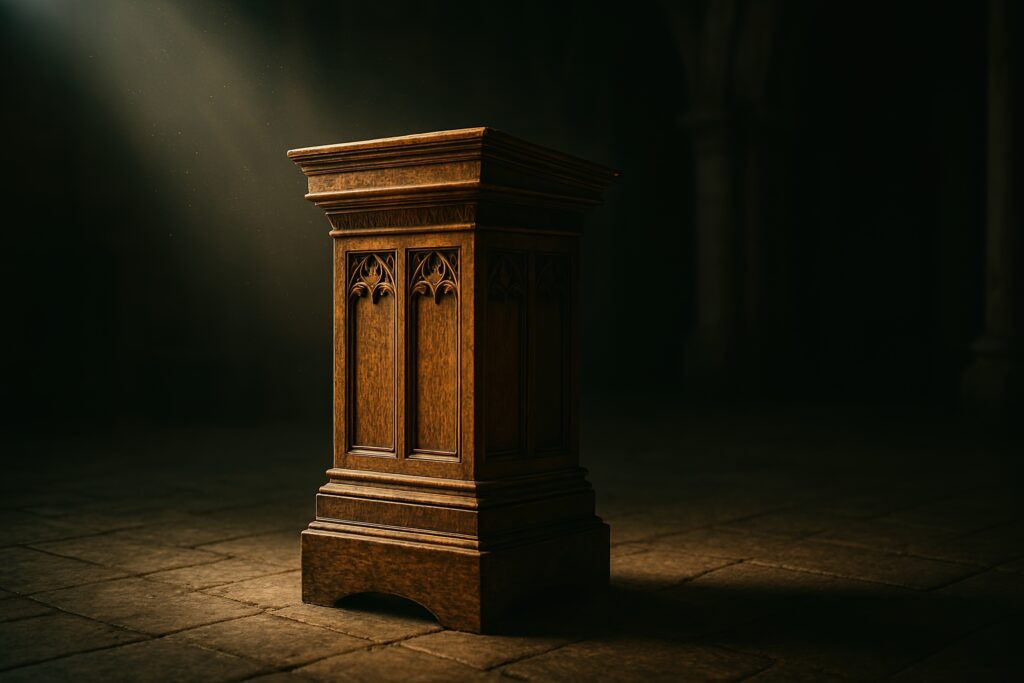
In one of the most morally charged moments in recent memory, too many pulpits flinched. Their silence and equivocation reveal a deeper sickness in evangelicalism: the neglect of God’s moral law. A pulpit without the law cannot name evil as evil and goodness as good. It cannot convict the conscience or point sinners to the only Savior. And a lawless pulpit cannot stand against a lawless age.
A pulpit without the law cannot name evil as evil and goodness as good.
This pulpit deficiency, especially in churches that identify as theologically conservative, did not arise overnight. In many ways, it is the fruit of a movement that began with noble intentions but has led to a grave omission. Over the last two decades, evangelicalism has been saturated with the “gospel centered” movement. Much of the emphasis of this movement has been laudable. However, in practice, “gospel-centeredness” often became a pretext for completely neglecting God’s law.
What began as a desire to avoid moralism and legalism has resulted in an evangelical culture where God’s law is treated, at best, as a perfunctory prelude to a gospel presentation. Preachers rush to the good news while neglecting the very standard that makes the good news necessary. In doing so, they deprive their congregations of the moral backbone needed to confront evil, to disciple consciences, and to stand with clarity in a hostile age.
Recovering the Second Use of God’s Moral Law
The Protestant Reformers identified three uses of God’s moral law: (1) to expose sin, (2) to restrain evil in society, and (3) to guide the believer in sanctification. Calvin and Luther alike insisted that the restraining (second) use of the law is essential for both church and society.
The second use of the law is an act of God’s common grace by which He restrains the full effects of sin in a society consisting of both believers and unbelievers. This use of the law does not regenerate, but it restrains. It binds consciences, awakens rightful moral shame, and sets boundaries that protect human life and preserve civil order. John Calvin described this use of the law in the following way:
“[Unbelievers] are restrained, not because their inner mind is stirred or affected, but because, being bridled, so to speak, they keep their hands from outward activity, and hold inside the depravity that otherwise they would wantonly have indulged. Consequently, they are neither better nor more righteous before God. Hindered by fright or shame, they dare neither execute what they have conceived in their minds, nor openly breathe forth the rage of their lust. Still, they do not have hearts disposed to fear and obedience toward God. […] But this constrained and forced righteousness is necessary for the public community of men, for whose tranquillity the Lord herein provided when he took care that everything be not tumultuously confounded. This would happen if everything were permitted to all men.” (Calvin, Institutes Bk. II vii. 10)
In the aftermath of Charlie Kirk’s martyrdom, we are forced to reckon with the reality that the assassin did not act in a void; he acted under the influence of an ideology that has sought to remove the restraint of the moral law by repudiating the created order and exalting rebellion against God. To call that ideology anything less than evil is to lie.
When preachers refuse to exercise the second use of the law, it leaves the people of God morally disarmed. It leaves our society without the categories necessary to make sense of the moral chaos that increasingly defines our age. If the pulpit will not name lawlessness—specifically and boldly—then who will?
The Gospel Advances through Moral Clarity
Some argue that speaking to cultural issues is a distraction from the mission of the church. However, from the prophets of Israel to John the Baptist, God’s people have always been called to name sin for what it is. When pastors avoid naming sin in the name of peace, they do not preserve unity. Instead, they are derelict in their duty.
The murder of a man for his public witness to truth is not a “political” matter in the cheap sense—it is a profoundly moral matter. It demands that the church say, with unflinching conviction, that both this act of bloodshed and the demonic ideology that fueled (and celebrated) it are wicked.
Moral clarity is what so many visitors were looking for on Sunday: someone with the courage to name evil as evil. They did not need platitudes. They did not need equivocation. They needed the prophetic power of God’s law proclaimed from the pulpit against societal evil. Many, tragically, left without it.
When preachers refuse to exercise the second use of the law, it leaves the people of God morally disarmed.
These young unbelievers flooded into churches not because they wanted ambiguity, but because they wanted answers—answers to why a husband and father was murdered to the cheers of leftists, and what that bloodshed means in the eyes of God.
Here lies the irony: preaching the law does not hinder the gospel; it advances it. Unbelievers already know, however dimly, that the world is not as it should be. God’s moral law is written on their hearts and, through nature and reason, they can grasp certain moral truths. Thus, when a preacher refuses to name and condemn the sins that even the unbeliever can plainly recognize in society, he undermines the credibility of the gospel message. Why should an unbeliever believe a preacher about the sin in his heart if that same preacher won’t speak honestly about the public wickedness everyone can see? Silence in the face of what is obvious to all forfeits the moral credibility to proclaim the truth of the gospel.
A Call to Courage and Clarity
This past weekend was an inflection point. The eyes of the nation were, in many cases, fixed upon the pulpit. Praise the Lord that many churches were faithful to the whole counsel of God’s Word. But far too many pulpits faltered. Instead of the bold proclamation of God’s law and gospel, many congregations received evasion wrapped in the veneer of pietism.
The church cannot afford such cowardice. If pastors will not speak with clarity when a godless ideology motivates and celebrates bloodshed, when will they? If churches will not name evil when the evil is so obvious that even the unregenerate can see it, then when will the church speak up? If Christians continue to prioritize cultural approval over moral clarity, they will discover too late that they have no witness left in a culture descending into open rebellion.
The choice before the church is stark: either we will retreat into silence as the next generation is catechized by lies, or we will love our neighbors by working to restrain that which God calls evil and promote that which God calls good. One path leads to irrelevance and judgment. The other leads to faithfulness, and by God’s mercy, revival.
- For some examples of how different pastors addressed these questions, see: https://founders.org/articles/pastoral-reflections-on-the-murder-of-charlie-kirk/; https://truegraceofgod.org/resources/sermons/the-flood-of-gods-judgment/; https://centerforbaptistleadership.org/im-a-pastor-heres-what-im-going-to-say-about-charlie-kirk-tomorrow-from-the-pulpit/ ↩︎