




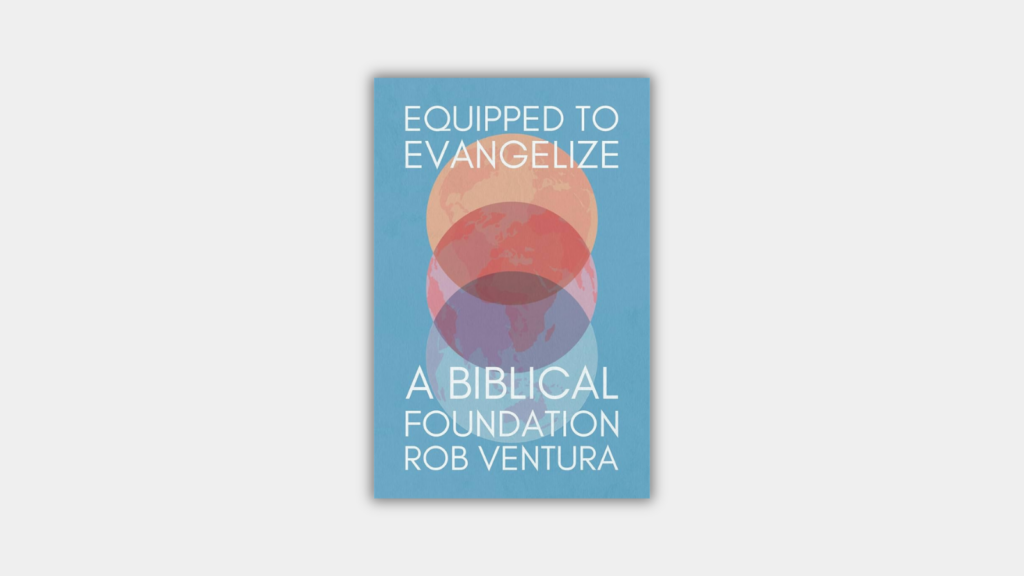

Equipped to Evangelize: A Biblical Foundation
By Rob Ventura. 104pp. Fern, Ross-shire, Great
Britain: Focus, 2025. 9781527113220
In the Reformed community, current discussions and books on evangelism focus on apologetic methodology. Recently, a resurgence of classical apologetics has reignited a critical examination and subsequent defense of presuppositional apologetics. While these debates act as “iron sharpens iron” when done in charity, it has overshadowed a larger concern—evangelism itself. A Christian’s main task is to share the gospel with the lost rather than engaging fervently with one another about the right apologetic approach. To that end, Charles Spurgeon wrote, “Soul-winning is the chief business of the Christian minister; indeed, it should be the main pursuit of every true believer.” 1
To fill this needed void for a Reformed book on evangelism, Christian Focus has published Rob Ventura’s Equipped to Evangelize: A Biblical Foundation. He serves as a pastor at Grace Community Baptist Church in North Providence, Rhode Island and has written many books on Reformed doctrine and practice. This work grew out of a sermon series to train his congregation on evangelism.
Why did he write this book? Throughout his decades of pastoral experience, he has “encountered individuals who felt hesitant to speak about their faith.” Considering his audience is for the person in the pew, Ventura organized his book into seven chapters with questions for reflection and discussion at the end of each one. It covers the need, scope, motive, agents, message, results, and power of biblical evangelism. He writes in a lucid style appropriate for his audience. This book has accomplished his objective and will be useful in helping any believer learn the scriptural view of evangelism and spot the false views which have become embedded in the broader church.
I will highlight four strengths in this book. First, Ventura does not assume the gospel. In Chapter 5, he goes through the four elements of the good news. His approach mirrors Greg Gilbert’s book, What is the Gospel? 2 Elementary instruction requires knowing the basic definitions. Many Christians use the word gospel, but they turn into a deer looking into the headlights when you ask them to define the word. According to Spurgeon, the gospel “is not a magical incantation, or a charm, whose force consists in a collection of sounds; it is a revelation of facts and truths which require knowledge and belief.”
Ventura also makes the distinction between the gospel and sharing one’s testimony3. They are not synonymous. Explaining how a person came to know the Lord is not the same thing as telling individuals to repent and believe in the crucified and resurrected Christ.
Second, having grounded the reader in the gospel, Ventura challenges him to share it with everyone including homosexuals, transgenders, liberals, Muslims, etc. Like Jonah who ran away from Ninevah, Christians have prejudices which cause us to flee from handing a tract or asking a person about his soul. Thus this book exhorts believers to evangelize for two motives—the glory of God and the love of neighbor. For Christians to have the glorious gospel of grace, which saved
Paul the great persecutor of the church, and not share it with all types of people is hatred, not love. Ventura makes love the passion for sharing with the lost.
Third, this book sets reasonable expectations for believers who begin evangelizing. Ventura pastorally instructs them to anticipate two responses, either acceptance or rejection. In zeal, a new follower of the Lord may be blindsided when an evangelistic effort turns into a heated argument. At the same time, the mature believer may need to be awakened out of any calloused cynicism and be reminded that God still saves sinners. Ventura’s teaching addresses both groups.
Fourth, while being a Reformed book that discusses God’s sovereign grace in predestining and saving the elect, it also emphasizes the power of the Holy Spirit to save. So often the Holy Spirit is forgotten in books on preaching and evangelism. Ventura offers a succinct systematic overview on the person and ministry of the Holy Spirit. The One who saves sinners matters as much as the practical steps to evangelize. Ventura’s contribution, therefore, counteracts evangelistic strategies that flow from Arminianism like the altar call and the sinner’s prayer. Hence, Christians, even young ones in the faith, should evangelize, because the power lies in God and not in themselves.
Even though Ventura’s work should be used for evangelism training in Reformed churches, he could improve the book in two ways [churches could expand the training by considering two additional points.] First, he did not address when a person should stop evangelizing specific individuals. Jesus taught in Matthew 7:6, “Do not give dogs what is holy, and do not throw your pearls before pigs, lest they trample them underfoot and turn to attack you (ESV).” When does a wife stop trying to evangelize her unbelieving husband? When does an open-air preacher stop conversing with a hostile mocker? When does a Christian stop talking about Christ to his homosexual neighbor? Should you evangelize to someone who is drunk or high on drugs? At some point, a Christian has to determine if his efforts to share the gospel with someone is making it worse. In those circumstances, he must pray for God to plow the unbeliever’s heart and produce soil ready to hear and believe the gospel. To that end, the book could have had [Ventura could add] two to three pages explaining and applying Matthew 7:6.
Second, one of the main reasons Christians are hesitant to share the gospel is they do not know how to practically steer the conversation to spiritual matters. To be fair, Ventura did not attempt to write a system of evangelism like Ray Comfort or James D. Kennedy. In fact, he eschews a cookie cutter approach and assures readers that you can talk about one or all four aspects of the gospel with a person. The believer’s conversation depends on the one to whom he is witnessing. Yet this short work would not be made into a tome if he provided illustrations and common questions to ask unbelievers to help the reader move from being established in the theology of evangelism to engaging in it.
Despite these suggestions, Ventura has created a book—which has long been needed—to train the saints to engage in the Great Commission. By grounding witnessing in the Bible, he proves Calvinism fuels evangelism instead of them being adversaries. The missionary movement began with 18th century Baptists who believed in predestination and the power of the Holy Spirit to save the elect through the preaching of gospel. Our churches, however, will become the stereotypes which we abhor—the frozen chosen—if we do not teach every generation to love the lost and to pursue the perishing. To that end, this book is a tool to keep evangelism as a main pillar in the work of our churches.
1 C.H. Spurgeon, The Soul-Winner; or, How to Lead Sinners to the Saviour (New York: Fleming H. Revell Company,
1895), 9.
2 Greg Gilbert, What is the Gospel? (Wheaton: Crossway, 2010).
3 Spurgeon, The Soul-Winner, 15.