






Mark 15:16–16:8
I. Mark 15:16–20 – Jesus was mocked by the Gentiles.
A. Pilate, having consented to the crucifixion of Jesus, turned him over to the soldiers that they might finalize the preparations for this gruesome form of capital punishment.
As this preparation proceeded, they took advantage of such a lowly and hated commoner to give vent to their propensity for jest and crudeness. After all, the subject was detested by his own people and on the verge of death. What was the harm of that?
-
- They invited all the members of their battalion that were present in Pilate’s headquarters to join with them in this brief frolic. It could have been up to 200 men (16).
- They engaged in a cruel irony. Already purpled in blood and bruises, they robed him in a like color to mock his consent to kingship (15:2) and heighten the contradiction between this claim and his condition of helplessness (17, 18).
- Their salutes to him were in the form of continual striking and their shouts of mocking praise were perforated by their foul spittle (19).
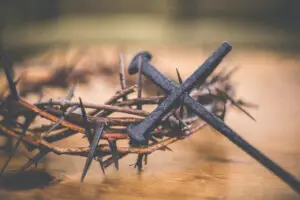
- The crown was not merely common and inglorious hay or branches but the positively cruel and painful tapestry of thorns, pressed on his brow; little did they know that they showed that he was indeed becoming a curse for us (Genesis 3:17b–18a; Galatians 3:13).
B. It is to this group that Peter refers in the sermon at Pentecost when he accused the Jews, “You crucified and killed by the hands of lawless men.”
The idea of lawless men could mean their intrinsic spirit of refusing to be ruled by any external standard of legal procedure or of common decency, or it could mean specifically the Gentiles “who have not the law,” (Romans 2:14).
C. Paul refers to them as the “rulers of this age,” (1 Corinthians 2:8) who would “not have crucified the Lord of Glory,” had they understood the decree of God.
The merciless and scurrilous behavior of the soldiers was natural to them, but God’s decreed purpose hid from them any knowledge of the ultimate purpose of God in these events. Had they perceived the overwhelming and majestic power of the glory of God as being worked out in the very events that they were executing, they would, out of a sense of fear and ultimate self-preservation, refuse to be anywhere near those events.
D. Though the entire incarnation constituted an emptying for the Son of God, these moments peculiarly demonstrate its extremities.
These moments of the spiritual and physical agonies leading to crucifixion consummate the greatest absence of the manifestation of the Christ’s intrinsic glory and infinite dignity as Son of God. In the moments that were most strictly endured to the glory of God (Ephesians 1:6, 7; John 12:27, 28) and in demonstration of love to man (Romans 5:8), we find the most thorough hiding of personal glory.
II. Mark 15: 33, 34 – Jesus was forsaken by the Father.
A. Verses 21–32 describe the wild, turbulent, and insulting scene at the cross.
He refused to anesthetize his suffering in any sense for he must endure it all. They gambled for his garments, he is ridiculed by robbers, given a thick dose of scorn by the common rabble, and taunted sarcastically by the Jewish religious leaders. A contemptible parody of his claims was hurled in his face like verbal garbage with no sense of the monumental truth or the saving power of his true statements.
B. As a culmination of the intensifying nature of Jesus’ bearing of divine wrath, the moment of complete abandonment brought forth the words of Jesus, “My God, my God, why have you forsaken me?”
As the man enduring the wrath in our stead, Jesus felt the loss of every vestige of the sustaining mercies of God; every common grace that supports every creature in all the world could not be found in the forty cubic feet of space occupied by the center cross, and the man on it knew palpably what it was to be completely abandoned.
C. But not only abandoned was he, but the recipient of the active wrath of God; he is set forth as a propitiation by the Father Himself, that he might save us from the wrath to come (1 John 4:10; 1 Thessalonians 1:10).
His cry testified to the truth that “He himself bore our sins in his own body on the tree,” and that God, in Christ, was reconciling the world to Himself (1 Peter 2:24; 2 Corinthians 5:19). It was indeed true as the scribes had mockingly scolded, “He saved others; he cannot save himself” (15:31).
D. Note this, the forsakenness occurred toward the man Christ Jesus in his mediatorial role (1 Timothy 2:5, 6), not to the Son of God proper as he stands eternally related to the Father by generation.
The Savior is one person, but exists in two distinct natures, “the distinction of natures not being taken away by the unity of the Person” (Creed of Chalcedon). The divine nature itself that includes the distinct personhoods of Father, Son, and Spirit necessarily includes the eternal generation of the Son, a relationship that by its infinite, eternal, self-existent, and unchangeable nature could never cease to exist. The cry, therefore, is a recognition that in our nature, the Messiah is bearing the whole of wrath divine for his sheep and he will not fail to bring them to himself (John 10:14–16; 17:18–21).
E. The First London Confession (1644) states the relation this way:
“He was priest, according to both natures, he was a sacrifice most properly according to his human nature” whence in the Scripture it is wont to be attributed to his body, to his blood; yet the chief force whereby this sacrifice was made effectual, did depend upon his divine nature, namely, that the Son of God did offer himself for us. He was the altar properly according to his divine nature, it belonging to the altar to sanctify that which is offered upon it, and so it ought to be of greater dignity than the sacrifice itself.”
III. Mark 15:37–39 – Jesus died and the New Covenant began.
Mark records Jesus’ death, with a loud cry, and then highlights two events that isolate distinctives of the new covenant.
A. Whether Mark has in mind, “It is Finished,” (John 19:30) or “Father, into your hands I commend my spirit,” (Luke 23:46), he wanted to show that Jesus still had vigor at the time of his death, for he uttered a “loud cry.”
It was thus that his death was voluntary, not only, “for the joy set before him,” submitting to all the events in obedience to the will of the Father, but that he controlled the moment that he would breathe his last, even as he does of all other living things. None took his life from him, but he gave it of his own accord (John 10:17, 18).
B. The rending of the veil of the temple (38) signified the end of all the ceremonies and types that now were fulfilled in the person and work of Christ (Hebrews 10:20 ; 9:15 ff).
By the shedding of the blood of his body, Jesus opened for us a way behind the curtain that divided the people from the high priest on the day of atonement. This rending of the veil symbolized that no more sacrifice was needed, the way into the presence of God was now made clear through the sacrifice of Christ.
C. The testimony of the soldier is the immediate fulfillment of Jesus’ words, “If I be lifted up, I will draw all men to me.”
The soldier saw the way that Jesus “breathed his last,” with strength still present and with resolve to lay down his life in this sacrificial event, and became the first, after the death of Christ, to give the confession of faith, “Truly, this man was the Son of God.” He obviously knew the accusations put against Jesus by the Jewish political and religious powers, he had seen the patient suffering of Christ, had heard his words, and now, seeing the manner of his death, is convinced that, in spite of all the ridicule and doubt of the accusers, Jesus’ testimony to himself is true. Jesus has begun gathering to himself by the certain efficacy of his redemptive death the people of every tongue and tribe and nation (Revelation 5:9).
IV. Mark 15:42–47 – Jesus was buried.
It is remarkable that Paul includes in his recitation of the gospel that he preached and which the Gentiles of Corinth received, “That Christ died for our sins according to the Scripture, and that He was buried, and that he rose again on the third day according to the Scriptures” (1 Corinthians 15:3ll, 4). The continuity of the events is to show that the same body that was buried also was resurrected. The death was certain, the resurrection was not less than physical, bodily, and in continuity with the body that was placed in the tomb.
A. It was on the day of preparation before the Sabbath.
The burial had to occur before nightfall on Friday in light of Sabbath observance. That meant that Jesus was in the tomb on three consecutive days, but only two nights. Any part of a day was calculated as inclusive of the entire day. So, when Jesus said, “For as Jonah was three days and three nights in the belly of the great fish, so will the Son of Man be three days and three nights in the heart of the earth,” (Matthew 12:40) he does not establish a contradiction with what actually occurred. He was in the tomb one full day, Saturday, and two full nights, Friday and Saturday, but parts of three days, Friday, Saturday, and Sunday. He was buried late on the sixth day of the week and rose early on the first day of the week. Thus, “three days and three nights,” means that his body was truly dead, and occupied the place of a dead body on three consecutive days.
B. Joseph of Arimathea took initiative to bury Jesus (15:42–47).
-
- Till this time, he had been a secret disciple and had feared the Jews’ declaration to cast Jesus’ followers out of the synagogue (Luke 19:38). Nicodemus came with him and provided spices (John 19:39) giving support to Joseph as they now gave public professions of their esteem of Jesus and apparently their conviction that he was the one to usher in the kingdom of God –“who himself was waiting for the kingdom of God” (43).
- His prominence is mentioned here and his riches in Matthew (27:57) to show why Pilate, always responsive to political clout, would hear him on such short notice. In addition, Pilate believed in the innocence of Jesus, sought a method by which he might be released (Matthew 27:17), and had even been warned by his wife to “have nothing to do with this just man” (Matthew 27:19).
- They did not want the body of Jesus to be given an ignominious burial after a brutalizing descent from the cross. This, in God’s providence (cf. Isaiah 53:9), though crucified as wicked and along with the vilest of transgressors, yet his burial itself began his vindication as the just one. Even the linen speaks of purity (Revelation 19:8).
C. Pilate ascertained his death (44, 45).
Pilate was surprised that Jesus already was dead. He sent, therefore to the centurion who officiated at the crucifixion, had seen the manner in which he died, and had confessed Jesus’ deity (Mark 15:39) to determine with certainty that Jesus was dead. In his interview with the centurion, he determined that this was true—Jesus already was dead. Other soldiers had verified this in addition to the account of the Centurion, for they had broken the legs of the other crucified ones to hasten their death. They saw that Jesus already was dead and did not break his bones but pierced his side (John 19:32–34) giving further evidence that his heart had ceased its operation.
D. The body was wrapped carefully, even as at his birth (Luke 2:7), so at his death.
Mark records that Jesus was wrapped in a “linen cloth.” John says that they “bound it in strips of linen with the spices, as the custom of the Jews is to bury” (John 19:40). The “shroud of Turin” that has caused such interest is a solid sheet. Explanations of the images on it are intriguing. It seems, however, to be inconsistent with the description of the manner in which Jesus’ body was prepared for burial. Some have said that a sheet was first placed over Jesus, both front and back from the feet to the head before the wrapping and this accounts for the sheet. John’s description of the manner in which the cloths were placed in the tomb after the resurrection (John 20:6, 7) does not seem to give warrant for the presence of a full sheet.
E. The placing of Jesus’ body in the tomb was observed by Mary Magdalene and Mary the mother of Joses.
This is further evidence that indeed it was Jesus who was wrapped and laid in the tomb. Evidently, Joseph was using a tomb that he had procured for the use of his family. Did he suspect that Jesus would not occupy it for many days?
V. Mark 16:1–8 – Jesus rose from the dead.
These verses appear to be the earliest manuscript evidence for the end of Mark. Verses 9–20 contain attempts to give an ending with more literary resolution by conflating other accounts of the events following the resurrection. As it stands, however, ending with verse 8, the ending leads the reader to bring into focus the single most credible explanation for all that has been said up to this point. Jesus, the ransom for many, the Son of God, has suffered as he predicted and has risen from the dead as he predicted (8:31–33; 9:30–32; 10:32–34; 12:10 “The stone that the builders rejected has become the cornerstone.” Mark 14:24–28). Thus, all the claims, instructions, admonitions, and warnings that he connected with the resurrection are true: He is the cornerstone, He is the ransom for many, He is the Son of Man prophesied, and He is the Son of God.
A. Verses 1–3 – Having prepared spices for the buried body of Jesus, the women mentioned got an early start, before sunrise, and probably arrived just as light broke [look at the accounts in Matthew 28:1f;Luke 24:1 f, and John 20:1f].
Their affection for Christ outran their realism, for they knew that they had no access to the body in light of the largeness of the stone, but hoped that someone might be there that would allow them at least to anoint the body. The close guard of the tomb combined with the Jewish paranoia of the possibility of stealing the body increased the difficulty of their mission. They could not, however, simply dismiss the memory of Jesus with a sigh and a shrug and go about their business just as if he had never been there.
B. Verses 4–7 – What seemed to them the first great difficulty had already been removed, for the stone had been rolled back for easy entrance.
In addition, the appointed guards had fled after experiencing the biggest fright of their lives. Replacing the Roman guard as a watcher of the tomb was an angelic presence [cf. Luke 24:2, John 20:12] that announced that the one they sought was not there but, as he had told them on several occasions, had risen from the dead. For verification he made sure that they looked at the place where the body had been laid. The angel also reminded them that he had told them to meet him in Galilee after he rose (7; 14:28).
C. The sudden change of perception so startled these women that for a time, they were unable to speak.
The angel, however, had instructed them to tell his disciples, which eventually they did. Mark’s version is so compact that we need the other accounts to give a more detailed version of the entire phenomenon. Mark intends for us to sense the simple, startling, and astonishing impact of this first awareness that the crucified and buried Jesus had risen. He is not here—He who was placed here in this grave is no longer in this grave—He is risen.
VI. This event puts in focus the details of the arguments that Paul enforces in 1 Corinthians 15 concerning the centrality of the resurrection as the capstone of the redemptive power of Christ’s passion.
Paul’s doctrinal concern is that the bodies of the redeemed people will be raised in a glorified state, fit places of residence for their purified, holy, and expanded spirits, intellect, affections, and will. His defense of the resurrection of the body as a reality uses the necessity of the resurrection of Christ as the most powerful evidence for resurrection per seand specifically the resurrection of the bodies of the saved.
A. Paul mentions other appearances of Jesus in verification of the historical certainty of his resurrection: to Peter, to more than 500 at one time, to James, to the twelve, and to Paul himself.
B. Paul then argues for the resurrection of Christ by showing the implications of His not rising.
-
- The preaching that the Apostles did is vain, that is empty and meaningless.
- Their faith is vain, for faith centers on the worthiness of Christ’s sacrificial death and present intercession as the just means of a sinner’s attaining forgiveness and right standing before God.
- The Apostles misrepresent God in their preaching, for they preach Christ’s resurrection whom God did not raise if the dead are not raised.
- Sin is unforgiven, for the due penalty for transgressions has not been executed and accepted as paid in full. The grave still holds the vehicle through which human affection, thought, and determination is expressed.
- The bodies of believers, in addition to their sensate spirits, will perish, so the hope of wholeness before God is gone.
- All suffering in the body in this life motivated by the hope of resurrection and of being like Jesus, seeing him as he is, is false and makes this present trouble a misery, not a joy.
- Death has not been defeated and so all things have not been and will not be placed under the feet of Christ.
But NONE of these things need plague our thoughts, for HE IS RISEN!
Poem
A Roman crucifixion stretched the scope of human pain.
Every nerve and organ wrenched and wrestled for relief.
None could come and only death remission could attain.
The scourge, the fists, the thorns, the nails—but these were not the chief.
Divine propitiation,
The Father’s sole oblation.
The Father’s wrath was finished, thus the Son plunged into death.
His body taken down and wrapped made ready for the grave;
Once more swaddled but no warmth, no choirs, no gifts, no breath.
But soon death must forsake its hold for Christ has died to save.
Joseph’s tomb released its prey;
Angels rolled the stone away.
The first-day dawn saw soldiers faint and followers perplexed.
An open entrance, empty tomb, an angel sitting near.
“The Lord is gone, what have they done, and what will they do next?”
The angel spoke and yet they left despairing and in fear.
The angel spoke words of life
To relieve eternal strife.
How should these words affect our hearts, “He is not here but lives.”
The crucified was in the grave, but death has lost its pow’r.
He bore our sins, He took our death, eternal life He gives.
Astounding truth, the curse of sin removed in that glad hour.
See the place where Jesus lay.
In that place He could not stay.
Glorified eternal man,
Sons of God with Him we stand.